AstraZenecaPart 2 of 5
Reviewing policy exceptions and rule changes
Two review flows beside the risk register. For policy exceptions, I prototyped how a reviewer reads a request and records a decision. For business-rule changes, I mapped how a requester tests a change and shows its impact before review.
- Contribution
- Product design, business analysis, and prototype implementation
Facts
- Engagement
- August 2025 to August 2026
- Contract title
- Senior UI/UX Business Analyst
- Responsibilities
- Requirements, interaction design, frontend prototypes, and shared design patterns
- Collaboration
- Business owners, medical specialists, product partners, designers, and model and backend engineers
Review a policy exception
Put the request beside the decision
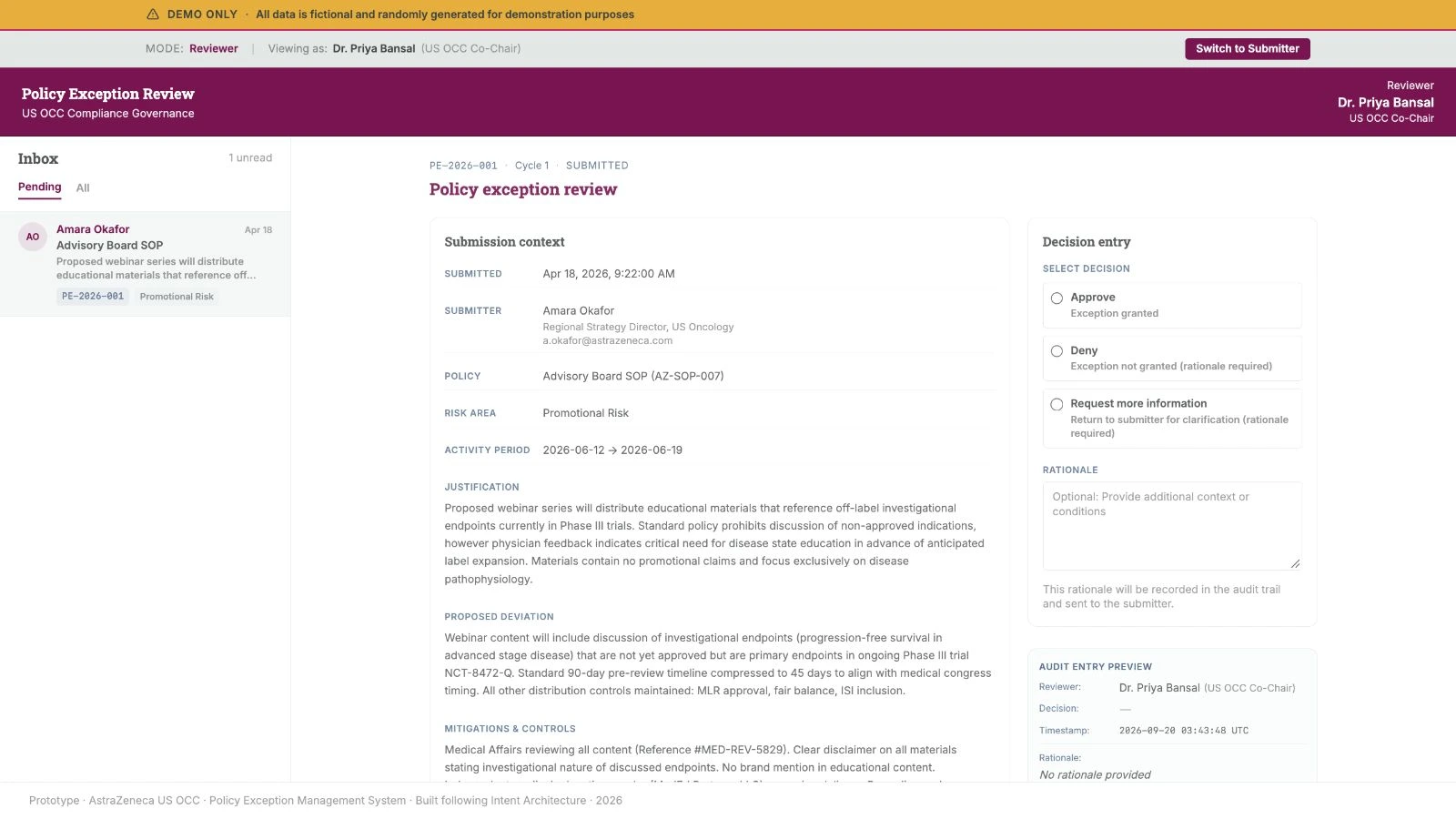
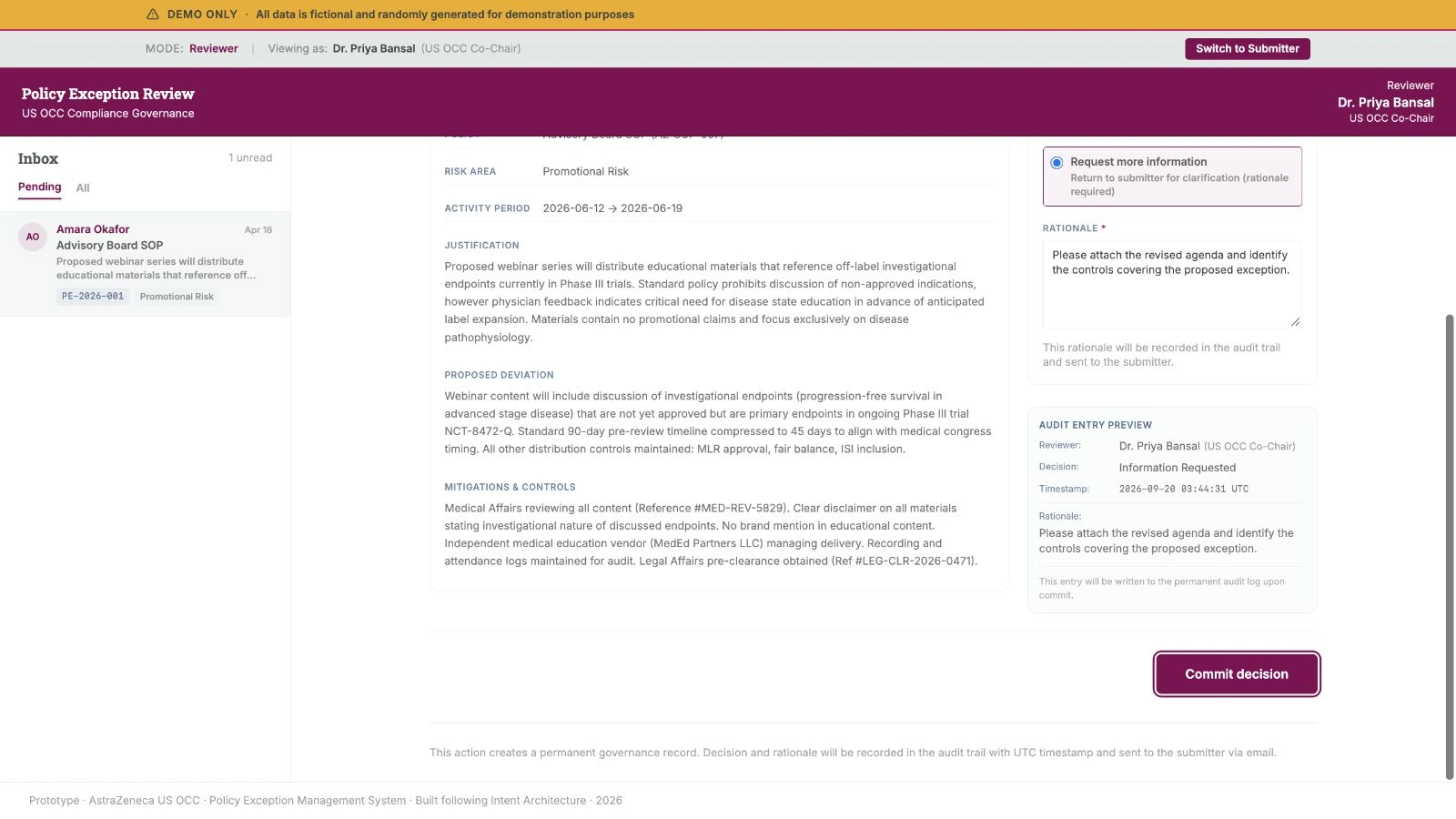
A policy exception asks permission to do something outside an existing policy. The reviewer needs to understand the request, why it is necessary, and what will reduce the risk. I explored that review experience alongside the submission process.
Compare the approval alternatives

Give the case more room
Make the review easier to scan
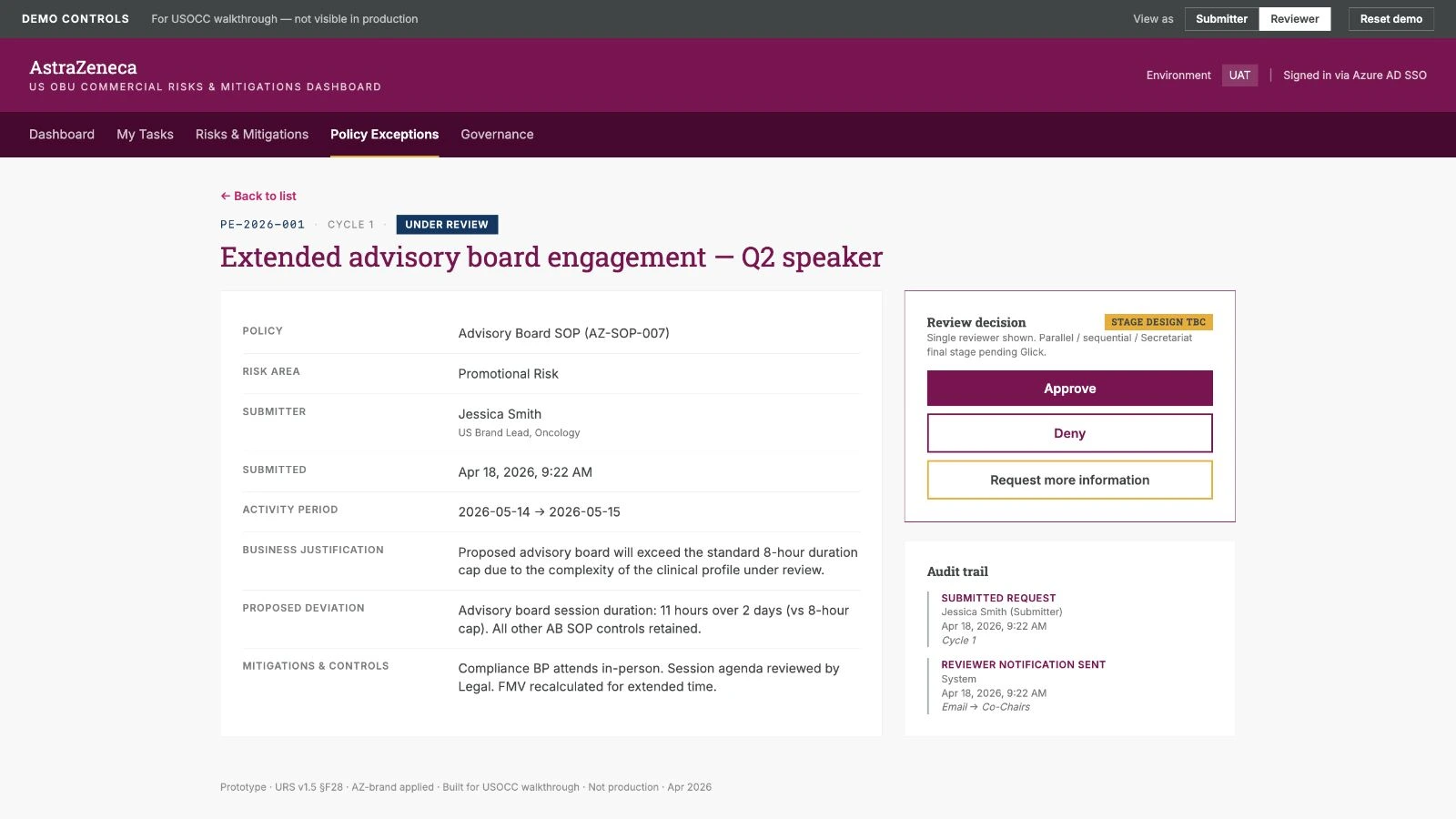
I tightened the typography and spacing so reviewers could scan the case, reduced the demo controls, and corrected the header colors. I kept the sample-data warning and role switch separate from the review controls.
Let the requester respond
Use the prototype to settle the open questions
In the April walkthrough, the business owner explained that there was no fixed committee quorum. Someone needed to record the final decision after the appropriate people had responded. The later requirements assigned that responsibility to a Compliance coordinator.
She also pointed out that someone seeing the prototype for the first time could mistake the sample requests for real cases. It needed a clear dummy-data label. After the walkthrough, she asked for the link to share with her team.
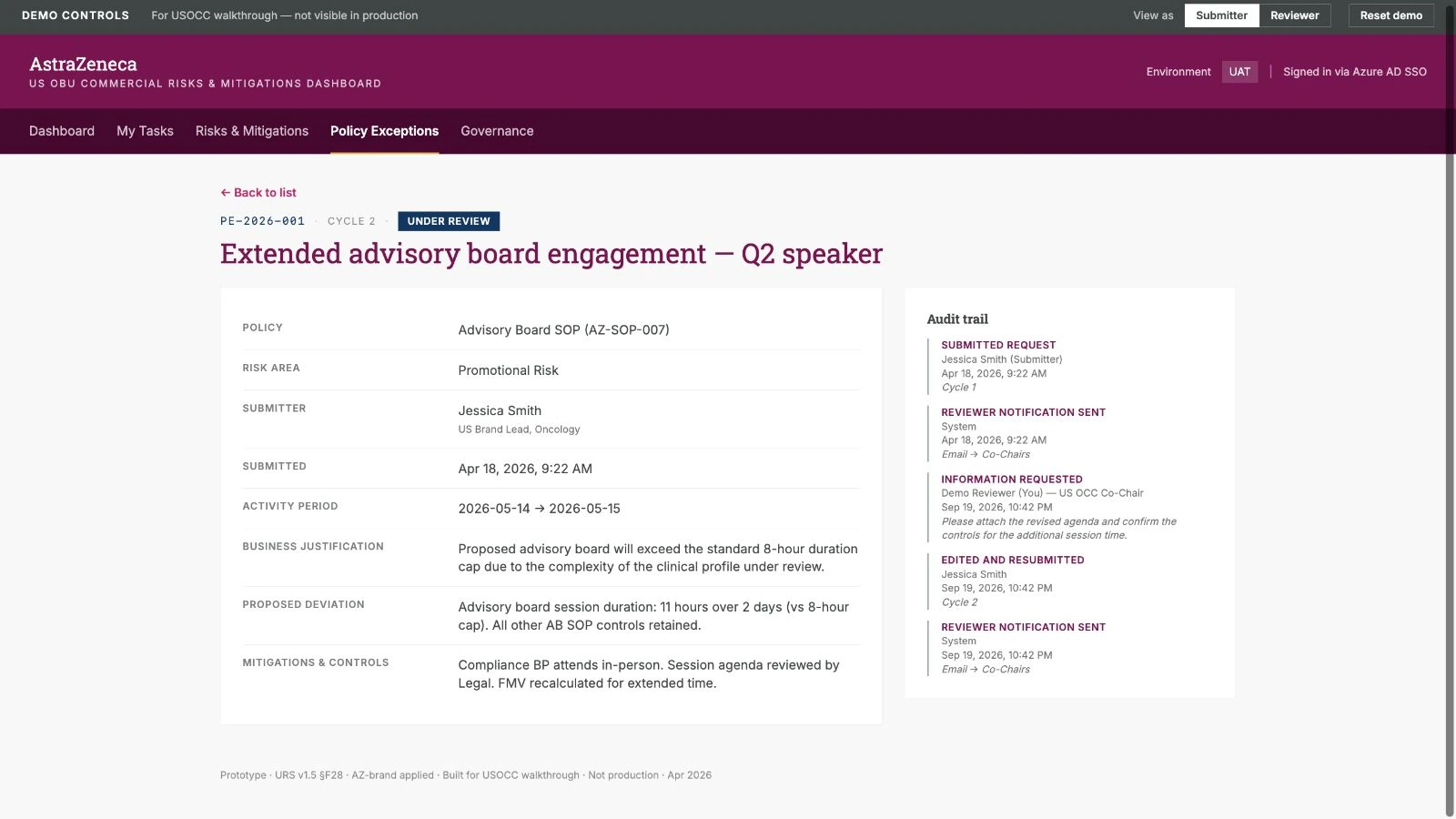
These earlier prototypes retain their own review models. They do not implement the later coordinator stage. The HTML walkthrough uses Deny and Audit trail; the later requirements use Decline and Version History.
Read the policy-review requirements and earlier flow
A separate proposal for policy exceptions
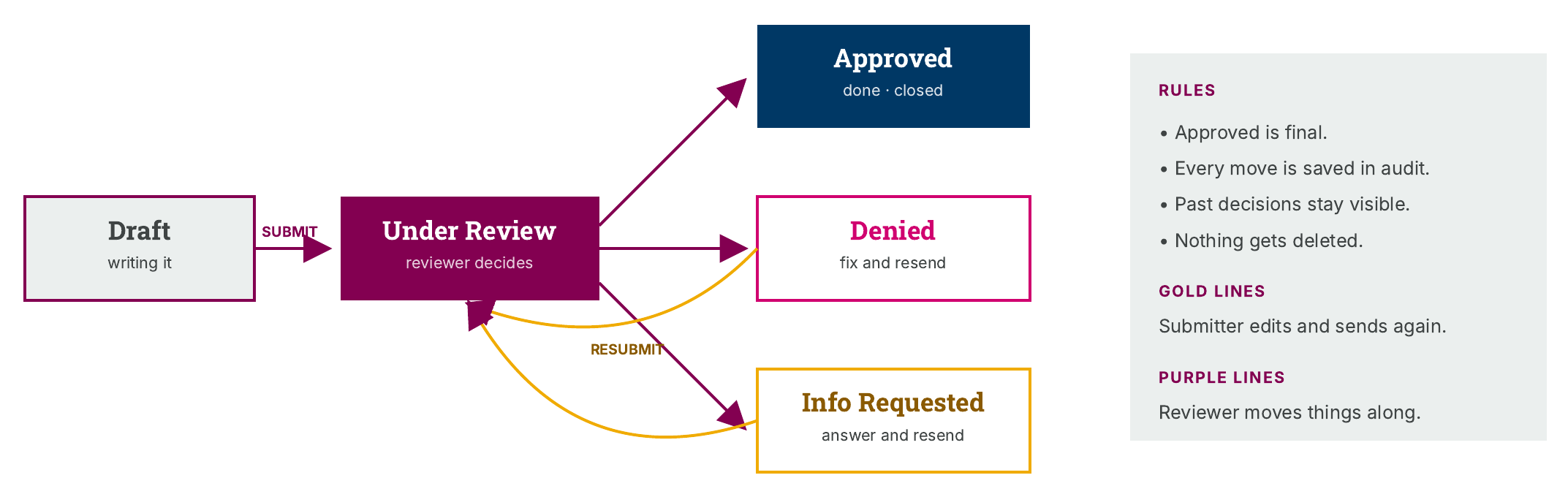
I specified a submission and review flow within the application. Reviewers could approve, decline, or ask for more information. Requesters could revise a declined request and submit it again, with the earlier decisions kept in its history.
The proposal assigned a Compliance coordinator to record the final decision after reviewers responded. It did not use an automatic majority vote. The review stages and role assignments still needed agreement, and the proposal required separate approval before it could proceed.
The separate policy-exception proposal
Review a business-rule change
Show the impact before asking for approval
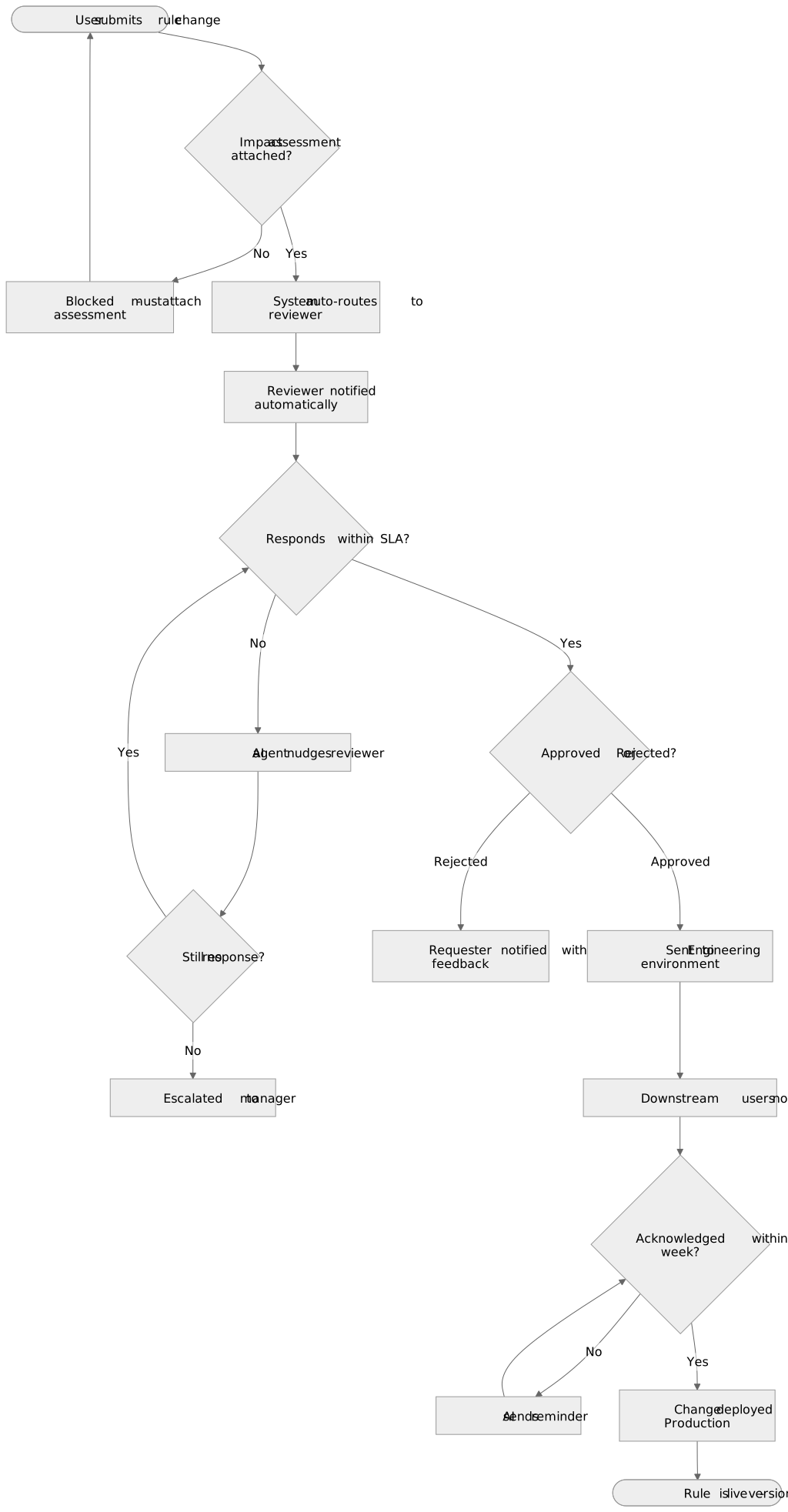
In a separate assignment, I mapped a portal for proposing changes to business rules. A requester would test a change and attach an impact assessment before submitting it for review. Engineers retained control over applying the change.
The original submission-to-release proposal
Zoom in, then scroll the diagram. With the diagram focused, use the arrow keys.
Keep the handoffs moving
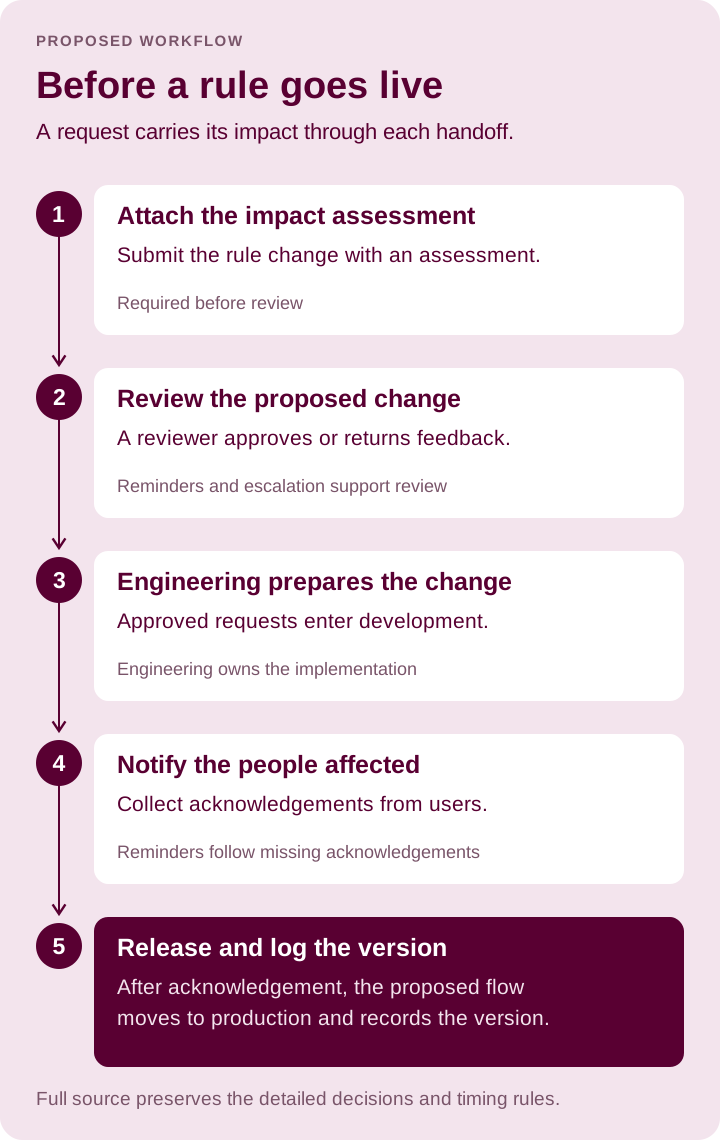
The proposed flow returned rejected requests with feedback, routed submissions to reviewers, and sent reminders when a response was missing. It also included escalation and reminders for users to acknowledge a change. Engineers remained responsible for applying approved changes.
The same proposal, read as five steps
Results
- I built policy-exception prototypes and used an April walkthrough with the business owner to settle who records the final decision.
- I specified a submission and review flow for policy exceptions, with approve, decline, and more-information outcomes and a kept history.
- I mapped a business-rule change portal from submission to release, with an impact assessment, reminders, and escalation.
Evidence limit
The policy-exception proposal needed separate approval before it could proceed, and the earlier prototypes do not implement the later coordinator stage. The business-rule portal remained a proposal, and engineers kept control over applying changes.